
-
24 June 2026
PigView Web Gets Smarter: Signal Recording, Playback, and Machine Learning for 22 Hz ELF Detection
Pig tracking has always had one frustrating truth at its core: if you missed a signal or weren’t sure what you heard, there was no going back. You had to trust your read of the moment, make the call, and live with the uncertainty.
Two new features in PigView Web are changing that. The first gives you a permanent, replayable record of every passage signal — so “I think that was the pig” becomes “here’s the proof.” The second uses machine learning to automatically separate real 22 Hz ELF passages from false alarms, so the data you’re acting on is data you can trust.
Here’s what these updates do and why they matter for day-to-day operations.
Streaming Data Recording & Playback: A DVR for Your Pig Runs
What It Does
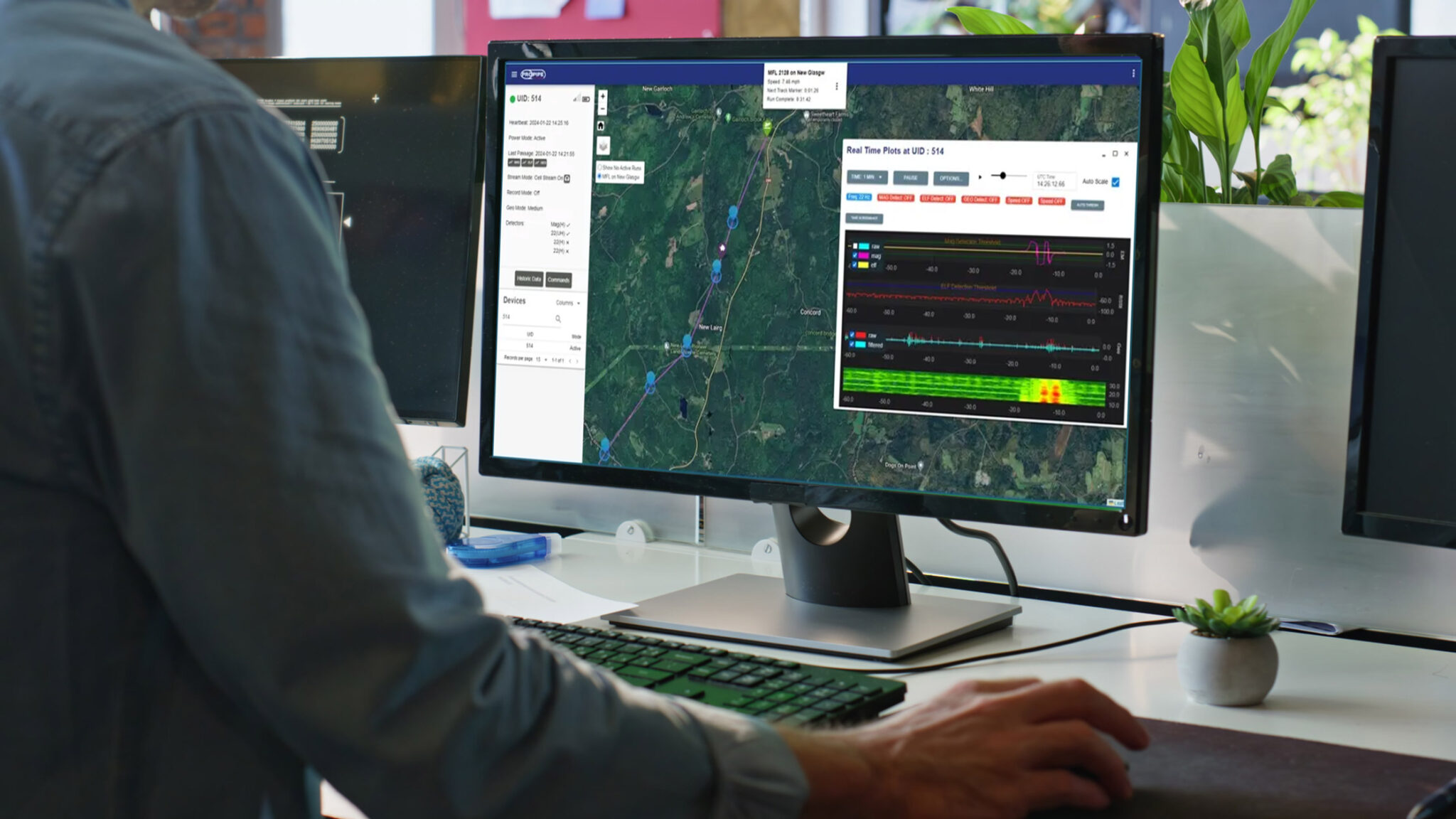
When your team is streaming live signal data from an APEX AGM during a pig run, PigView now records it automatically. The full passage — geophone (acoustic/seismic), ELF (22 Hz electromagnetic), and MAG (magnetic) — is captured in real time and saved to your account. After the run, you can pull up any recorded passage in the PigView web app and play it back: scrub through the timeline, zoom in channel by channel, replay the exact moment of detection.
Think of it as a DVR for your tracking data.
The Problem It Solves
Pig tracking is an active, real-time job. A passage can be brief, faint, or buried in environmental noise. If you’re listening to a weak signal on a foam pig with no ELF transmitter — just audio — and something comes through that might have been the pig, you have a split second to decide.
Until now, if you weren’t sure in that moment, you weren’t going to get a second look. The geophone data was only available at the end of the run when you downloaded it locally. If a remote or unmanned AGM detected something ambiguous, you couldn’t check it until someone physically retrieved the unit. You had to make your call and move on.
That’s a real operational problem. Pig tracking teams are coordinating across multiple locations — trackers in the field, analysts watching remotely, receiver crews waiting at the end of the line. Everyone is working from your detection calls. If the pig passed 45 minutes ago and you’re only now confirming it, those downstream teams have been sitting idle or, worse, have already made the wrong call.
How It Changes Operations
With recording and playback, the window for verification doesn’t close when the pig passes.
If you’re streaming live and something happens you’re not sure about — someone called you, a noise confused the read, the waveform looked unusual — you rewind and play it back. Right then. No waiting. No downloading. No “I’ll check when I get back.”
The same applies for remote AGM locations. A tracker working from an office in Calgary, monitoring an AGM in Texas, gets a detection and isn’t 100% certain. Instead of flagging it as probable and moving on, they replay the recorded passage, confirm the signature, and report it with confidence.
And after a run is complete, every recorded passage becomes reviewable evidence. Disputed detections, missed pigs, ambiguous timing calls — all of it can be revisited with the actual data instead of a recollection. That’s valuable for reporting, for QA, and for training less-experienced staff on what real passage signatures look like.
“The bottom line: Every passage is now a permanent record, not a one-time, in-the-moment judgment call.”
ML-Powered 22 Hz ELF Detection: Signal You Can Actually Trust
What It Does
PigView now includes a machine learning model specifically trained to analyze 22 Hz ELF signals and distinguish genuine pig passages from false detections. Each detection gets a confidence score. In the app, operators can filter by confidence level, with sensible defaults already tuned to common tool types — MFL, cleaning pigs, geometry tools — and the ability to adjust per-channel settings based on what the tool is expected to produce.
Why 22 Hz ELF Needed This
The 22 Hz ELF signal is one of the most valuable signals in pig tracking — especially for non-magnetic and smaller tools like foam pigs, cleaning pigs, and cups, where magnetic signatures are weak or absent. ELF is powerful precisely because it’s sensitive.
That sensitivity is also the problem. ELF picks up electromagnetic noise from the environment — power lines, heavy equipment, interference from adjacent pipelines — and that noise can look like a passage to a simple threshold-based filter. The result is false positives: detections that operators have to manually evaluate and dismiss before they can identify the real event.
This isn’t just inconvenient. False positives create doubt. When analysts are sifting through a list of potential detections trying to find the actual pig passage, they slow down, second-guess real events, and sometimes miss what matters. The noisier the channel, the less you trust it — which defeats the purpose of having it.
Why Machine Learning Is the Right Fix
A fixed threshold can’t distinguish between a genuine passage signature and a convincing piece of noise. Machine learning can, because it’s been trained on the actual characteristics of real ELF passage signals — the specific pattern that separates a true detection from interference.
The model applies that pattern recognition to every detection and assigns a confidence score. High confidence means the signal looks like a real passage. Low confidence flags it as likely noise. Operators still have final say, but instead of starting from a raw list of unknowns, they’re starting from a ranked, filtered view with the probable real events surfaced at the top.
As more data is gathered, the model continues to improve. That’s the compounding advantage of ML over static rules: it gets better with use.
What It Means Day-to-Day
Analysts spend less time on manual noise review and more time acting on real detections. Reports are cleaner. Reviews are faster. And the ELF channel — historically the most prone to false hits — becomes a dependable, confidence-scored detection source instead of a source of uncertainty.
For pipeline operators running cleaning pigs or smaller tools where ELF is the primary or only signal, this matters a lot. It turns a difficult, high-noise tracking scenario into one where the software is actively helping you find the real passage, not just presenting you with raw data to sort through yourself.
The bottom line: Noisy channel, trustworthy results. The ML model does the filtering so your team can focus on the run.
Two Features, One Outcome
Separately, recording/playback and ML-powered ELF detection each solve a specific, real problem in pig tracking operations. Together, they address the same underlying issue: confidence.
Pig tracking still requires experienced people making judgment calls in complex, variable conditions. These tools don’t change that — they back it up. You can replay the signal. You can see the confidence score. You can verify, document, and report with evidence instead of recollection.
That’s what reliable pig tracking looks like.
Reach out to learn how these updates fit your operations.
Pig Tracking Software FAQs
Pig run data recording is the process of automatically capturing and storing tracking signals generated during a pig run. In PigView Web, geophone, ELF, and magnetic (MAG) signals are recorded in real time, allowing operators to review, replay, and verify pig passage events after they occur.
Signal playback allows operators to revisit recorded pig passage data instead of relying solely on real-time observations. By replaying geophone, ELF, and magnetic signals, teams can verify detections, investigate anomalies, resolve disputes, and improve confidence in pig tracking decisions.
Machine learning analyzes the characteristics of real pig passage signals and compares them against environmental noise. Instead of relying on a simple threshold, the model assigns confidence scores to detections, helping operators quickly identify genuine pig passages and reduce time spent reviewing false positives.