
-
4 August 2026
What Does Pipeline Integrity Management Software Do? A Field-Focused Guide
Pipeline integrity management software collects data from field devices, inspections, and monitoring equipment, then organizes it so operators can find defects early, verify that maintenance actually happened, and prove compliance. In short: it turns scattered pipeline data into decisions — where to dig, when to clean, and what to report — before a small problem becomes a failure.
That’s the whole point of an integrity program. A pipeline can’t be inspected all at once or all the time, so operators rely on a steady stream of data — cleaning runs, inline inspections, pig-tracking passages, monitoring feeds — to build a picture of what’s happening inside the line. The software is what holds that picture together. Without it, you have data trapped in spreadsheets, PDFs, and someone’s memory of the run. With it, you have a record you can act on and stand behind.
This guide walks through what the software actually does day to day, the main types you’ll run into, and where field pig-tracking data fits — because that’s the part a lot of integrity programs still handle by hand.
The Core Jobs It Handles
Strip away the marketing and pipeline integrity management software does five practical things.
It centralizes pipeline data. Inline inspection results, cleaning run records, GPS-referenced locations, pig-tracking passages, and monitoring feeds all land in one place instead of a dozen. When every dataset shares a location reference, an integrity engineer can line up an inspection anomaly with the exact point on the line and everything else that’s ever been recorded there.
It verifies that work happened the way it was planned. A cleaning run only counts if the pig launched, passed every checkpoint, and reached the receiver. Good software timestamps each of those events so the run is confirmed, not assumed. This is where field tracking data and the integrity record connect.
It finds and prioritizes problems. By comparing inspection data over time, the software surfaces wall thinning, dents, metal loss, and corrosion that’s growing — so crews dig a known defect on a planned schedule instead of responding to a leak.
It supports compliance and reporting. Regulators want proof: what was inspected, when, what was found, and what was done about it. Software that archives every run and detection makes that reporting a query instead of a scramble.
It helps set smarter schedules. Years of archived run and inspection data show which segments need attention more often — so pigging and inspection frequencies are based on the line’s actual history, not a fixed calendar.
Pipeline integrity management software” isn’t one product. It’s a category, and most operators run more than one tool that falls under it.
Where Pig-Tracking Data Fits In
A lot of integrity software assumes the field data is already clean and confirmed. In real operations, that’s often the weakest link. If nobody can prove where the pig was when a passage was recorded — or whether it passed a checkpoint at all — then the inspection data tied to that run is built on a guess.
This is the layer PigView Software Suite is built for. It’s not a full risk-modeling platform, and it doesn’t pretend to be. It does one part of the job well: it confirms pig runs and turns every passage into verified, timestamped data your integrity program can trust.
Here’s how that works in the field. Intelligent EM transmitters mount on the pig and broadcast the industry-standard 22 Hz tracking frequency — programmable from 10 to 30 Hz to compensate for wall thickness, pipe diameter, and soil. Along the route, APEX Above Ground Markers confirm each passage using magnetic, low-frequency electromagnetic, and geophone detection — three ways to catch a pig even through heavy wall. Every passage is GPS-timestamped, and with LTE plus optional Iridium satellite, crews confirm passages from the truck or the office instead of driving out to sit on a checkpoint.
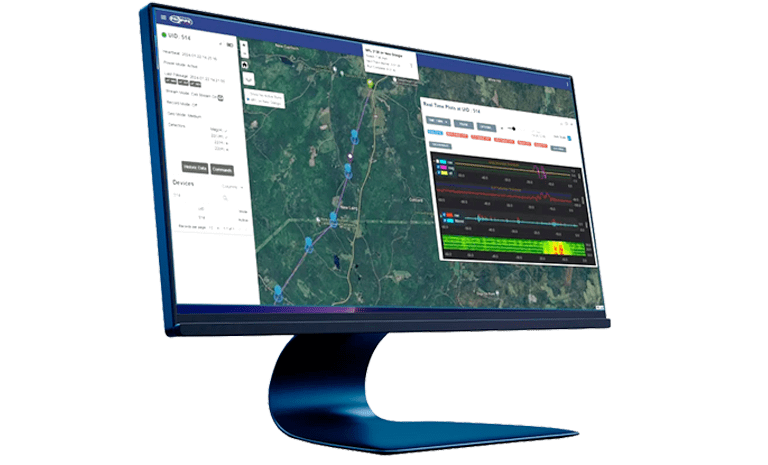
The software side is where that data becomes usable. PigView Web puts every AGM on one dashboard with the pipeline route overlaid, so integrity managers watch live pig positions against real geography. PigView records the full signal behind each passage, so an ambiguous detection can be replayed and confirmed instead of guessed. And PigView’s machine learning filters separate real 22 Hz passages from environmental noise — power lines, equipment, adjacent pipelines — so the ELF channel becomes a dependable, confidence-scored source instead of a pile of false positives to sort by hand.
The result is a clean, verified field record feeding whatever integrity platform sits above it. Better field data in means better integrity decisions out.
What to Look For When You Evaluate It
Whether you’re choosing a full platform or the field layer that feeds it, a few things separate software that improves integrity management from software that just stores data.
Look for verified, timestamped records — not just detections, but proof the run happened, accurate enough to correlate with inspection data. Look for data you can reach in the field, including offline, because pig runs don’t wait for good coverage. Look for signal you can review after the fact, so a disputed or ambiguous call can be revisited with the real data instead of someone’s recollection. Look for noise handling that earns trust, because a channel full of false positives is a channel your team stops believing. And look for archived history, because trend data over years is what lets you set inspection and cleaning frequencies based on the line’s actual behavior.
If you want to see what that looks like in practice rather than in theory, read how PPNA approaches pipeline integrity management software that works in the real world — built for field conditions, not just the demo.
Pipeline integrity management software exists to do one thing: turn pipeline data into decisions you can defend. The best programs pair a capable data platform with a reliable field layer, so the inspection results everyone trusts are backed by pig runs everyone can prove. Get that chain right — verified in the field, confirmed in the software, archived for next time — and integrity management moves from reacting to failures to preventing them. That’s also how crews get home safely at the end of the run.
Have questions about the field data side of your integrity program? Talk to our team or browse the Smart Pigging FAQ.
Pipeline Integrity Management Software FAQs
It’s software that collects, verifies, and analyzes pipeline data — inline inspection results, cleaning runs, pig-tracking passages, and monitoring feeds — so operators can find defects early, confirm that maintenance happened, and meet reporting requirements. It’s a category of tools, not a single product, and most integrity programs use several together.
It combines multiple detection methods — magnetic, electromagnetic, and geophone — and applies machine learning trained on real 22 Hz passage signatures. Each detection gets a confidence score, so operators start from a ranked, filtered view instead of a raw list of unknowns.
It closes the verification gap. Timestamped, GPS-referenced passages confirm a run completed, locate stuck pigs, verify tool speed stayed in spec, and tie inspection data to real locations on the line — so the integrity decisions built on that data rest on proof, not assumption.